Monday, May 11, 2020
Making TeeVee history
Back in the days of analog editing and a full head of hair, I volunteered at GRTV, the public access station in Grand Rapids Michigan. I was there, on and off, for about fifteen years. It was so much fun.


Thursday, January 26, 2012
How to Not Get Killed: A Sea Story
How can you tell when an old sailor is lying?
his lips are moving.
Sometimes that's true but here's a tale from the high-seas that happened to me when I was a young sailor-boy on the USS Dehaven back in 1972.

Here I am on the good old Dehaven (DD-727) a Sumner class destroyer from World War Two. It was a fine old ship with quite a remarkable combat record.
Be patient, this will get more interesting as you go along.
The Dehaven

What a beautiful ship. Note the gun-mounts forward (toward the pointy part) each contains two five-inch guns. They can hurl a 55-lb projectile up to ten miles or so with great accuracy. You can imagine that to achieve such a feat the gun must be complicated, well-engineered, and HEAVY

Here, Charlie Boothroyd stands at the rear of one of the guns, the sliding breach-block. It weighs a couple of tons, and when the breech "clicks" shut the gun fires and the block instantly (instantly) recoils about three feet rearward as the empty shell casing is ejected. So you certainly would not want to be standing behind it when it fires, right?
Although I was a Radioman on the Dehaven, I found myself working in the forward five inch gun mount for a couple of weeks. It was normally the battle station of the lowest ranking radioman on the ship. Unfortunately he, and the next lowest guy were both on leave, so I was called down to fill in.
At first I was down in the handling room sending projectiles and powder casings up into the mount. The handling room is a small piece of hell on earth, where you try to keep your balance on a greasy, moving deck, trying to not get your fingers crushed as you manhandle heavy projectiles from the magazine elevator into the ready racks and chain hoists which run them to the gun above.
Sounds like fun, right? Right.
As we were firing, from the small hatch above, appeared the grimy face of one of the gunner's mates up in the mount. While he was shouting the type of ammo to send up he spotted me, or actually, the petty officer insignia on my sleeve (the "crow") and inquired
"Hey a**hole, what the f@#k are you doing down there!? You're a godd%##ed petty officer, get up here with us."
Seeing this as a welcome reprieve I gratefully scrambled up the narrow ladder through the scuttle above and emerged into the ear-splitting, bone shuddering, deafening, reeling and jolting world of the gun house.
As the hot empty shell casings were ejected from the breach I was to grab them and toss them out a little scuttle that got them outside, out our way and out from underfoot.

They would pile up on the deck outside the gun mount. Sometimes, after a sustained period of firing, there would be hundreds of them out there, rolling back and forth with the motion of the ship
About ten guys worked the mount. It was so noisy that the only communication was done with hand signals; hand signals like the one I gave to the guy indicating that a casing had been lodged below the mount, impeding the elevation. I gave him the "finger across the throat" signal and indicated the jammed casing. He grinned, nodded, and gave me the "thumbs-up". The fact that he'd been toking reefer all morning had some bearing on what happened next.

As I bent down, head behind the giant breech block, remember? the breech block that instantly hurtles rearward the moment the breach "clicks" shut and the gun automatically fires? Yeah, that breech block.
Despite the smoky assurance of my shipmate of the "thumbs-up" signal, I heard that most frightening sound:

You know what happens at the click.
Instantly I felt myself flying backward; two huge, powerful, hands at my belt providing a jarring jerk clear of the breech block.


It all happened in the blink of an eye. I watched as the breech block rocketed before my eyes, filling the space where my head had been an instant before.
The guy who insured my continued future was a gunner's mate who I only ever knew as "Cracker". A greasy, portly, and altogether unkempt sailor who was, for me, the man of the moment.

As I thanked him profusely, he shrugged it off with " Yer lucky that was the last shot or I'da been too busy to bother"

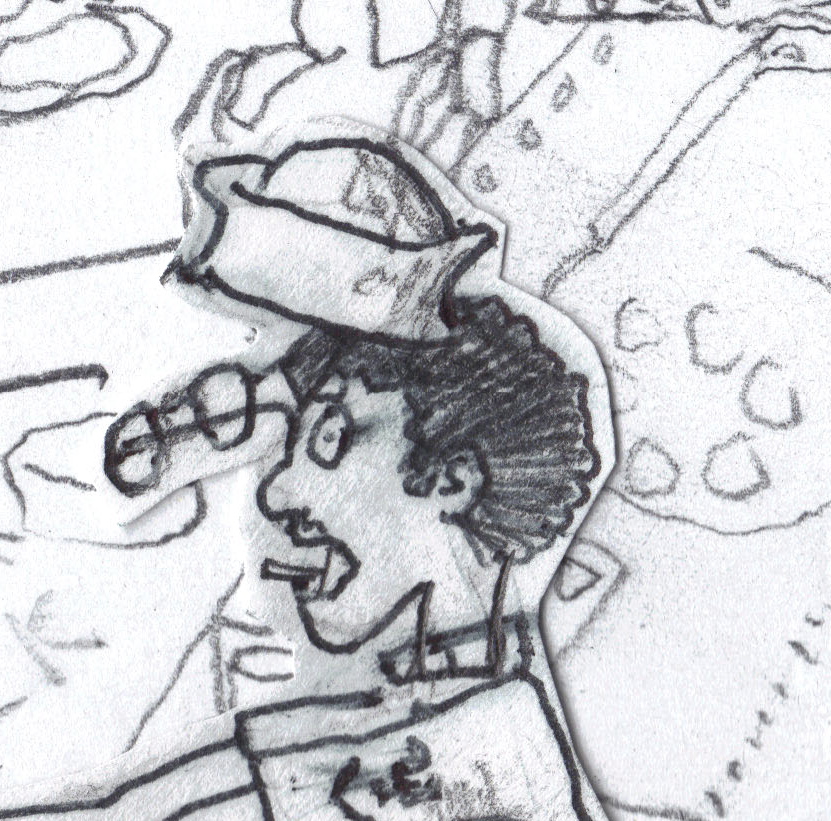
The guy with the bowl haircut: "Cracker"
And that's how I helped to defeat the commies.
Mannie
.
Thursday, November 24, 2011
Wild Ride
.
Not quite three years ago, when I was feeling very low, some of the best friends a guy could have - John Laura, Holly, Maura, Chris, Susann, Christie and Rory took me out to the local carnival.
It was three hours of delightful diversion.
Now years, later (and happy as a clam, thank you) I edited together stills and footage that I shot on that evening and put together a very silly and, I think, fun, send-up of a suspense/horror movie trailer from the 1980's Death Carnival of Fun Fun
You can enjoy it (or not) here.
Art continues to imitate Life
Mannie
.
Not quite three years ago, when I was feeling very low, some of the best friends a guy could have - John Laura, Holly, Maura, Chris, Susann, Christie and Rory took me out to the local carnival.
It was three hours of delightful diversion.
Now years, later (and happy as a clam, thank you) I edited together stills and footage that I shot on that evening and put together a very silly and, I think, fun, send-up of a suspense/horror movie trailer from the 1980's Death Carnival of Fun Fun
You can enjoy it (or not) here.
Art continues to imitate Life
Mannie
.
Friday, October 21, 2011
Wednesday, October 12, 2011


Friday, August 26, 2011
of valentines, tattoos, and furniture
No sooner had I finished my Burnside Bridge bookcase than my wife Susan asked me if I'd make her a small bookshelf, very small in fact, something for bedside use. I was happy to comply. I chose to make her a bookcase and a valentine all in one. This was on Tuesday.
By Wednesday morning I had the carcass glued up. Made in select pine with no blemishes, the cutting, and assembley went like a dream. As usual the screws were hidden with pegs and a cherry stain was applied overall.

As with all of the smaller bookcases I'm making this one has ergonomic hand-holds cut into the sides for ease in moving it about.
To personalize it I designed an old-school Sailor Jerry-style tattoo on the top surface.
First, I inked it in with a Rapidiograph pen,

the ink flows nicely even on the stained surface.

Then I added color, as usual using Prismacolor pencils which are always a pleasure to use, the colow seems to flow on, is very controllable, it saturates and blends like a dream.


The results were very gratifying, this is the valentine part I was referring to.
As usual, the unit was glued, clamped and screwed with pegs flush-cut to cover the screws.

I cut the hand-holds in more of a novel shape this time.


Two and a half days from concept to finished product,
The customer was very pleased!
Staying handy,
Mannie
Wednesday, August 10, 2011
Arsenal of Democracy
Those who know me are never surprised to learn of my ordnance collection; my artillery shells.
I've been collecting projectiles and shell casings since 1972 when I acquired my first one, a brass shell casing for a Naval 3" gun. I got it while it, and I, were still in the U.S. Navy. It's one of those things that "came home with me".
Shell casings and inert projectiles just seemed to gravitate toward me over the years, though more casings than projectiles. A few years ago, upon learning to operate a woodlathe, I began making the projectiles to go along with the empty casings.
Of my collection of twelve modern artillery shells (WWI to present) all of them are inert painted to appear active, and five of them are entirely made of wood.
Recently friends gave me a second empty three-inch shell casing. Last night I glued up five 5x14x5/8 inch boards as turning stock, and this morning I turned my latest projectile.


I've been collecting projectiles and shell casings since 1972 when I acquired my first one, a brass shell casing for a Naval 3" gun. I got it while it, and I, were still in the U.S. Navy. It's one of those things that "came home with me".
Shell casings and inert projectiles just seemed to gravitate toward me over the years, though more casings than projectiles. A few years ago, upon learning to operate a woodlathe, I began making the projectiles to go along with the empty casings.
Of my collection of twelve modern artillery shells (WWI to present) all of them are inert painted to appear active, and five of them are entirely made of wood.
Recently friends gave me a second empty three-inch shell casing. Last night I glued up five 5x14x5/8 inch boards as turning stock, and this morning I turned my latest projectile.
Here's my glued-up stock this morning. I've just taken a mallet and driven in the headstock of my lathe into the center of the piece. You can see that its just a big sandwich of glued and clamped boards.

I powered up my lathe and got to work making the chips fly...

and fly...

and fly.

I was using a profile that I had taken from an actual photograph of a 3" armor-piercing shell.

This profile served as my template for all measurements.

With my parting tool I dug down to a true 3-inch thickness as measured by calipers.

Working from left to right, I turned the driving bands and, here, I'm roughing out the windshield - the lightweight steel cone that covers the nose of the armor-piercing projectile within.

Finish sanding as I went along, the piece is nearing completion.

Here is the blank, this morning at 8:00 a.m.

Primed, at 10:00 a.m.

Painted at 5:30 p.m.

And with it's shipmates this evening.

Can you guess which ones are wood?
Staying busy,
Mannie
Monday, March 14, 2011

Thursday, March 3, 2011

Tuesday, March 1, 2011

Friday, February 25, 2011
Waiting for my Ship to come in.
There’s a port on a western bay
and serves a hundred ships a day
Lonely sailors pass the time away
And talk about their homes
And there’s a girl, in this harbor town,
And she…
That was as far as the song got before a sailor laid aside his pool cue, strode over to the communal radio, and disgustedly snapped it off. Romanticized versions of Navy life as envisioned by hippie musicians do not play well in a building filled with bored and irritable sailors.
It was my second day at the transit barracks. I’d just come off of 30 day leave following a 15-month deployment to the Naval Communication Station at Finegayen Guam in the Marianas Islands. It was great to be stateside again and it was with some anticipation that I awaited the arrival of my first ship, the destroyer U.S.S. Dehaven. I was literally “waiting for my ship to come in”.
The Dehaven was out on a two-week reserve training cruise and I had arrived at the Naval Station Long Beach, the Dehaven’s homeport, midway through that cruise. Upon reporting for duty at the Naval Station I was apprised of the situation and assigned a bunk in the transient barracks to await the return of my new ship.
A transit barracks is an earthly manifestation of limbo, or perhaps more like a very pleasant jailhouse, a jailhouse where the inmates can come and go as they please and order in pizza. A sailor in transit, if clever, has no duties while in that status, unless, of course, that sailor carelessly announces his presence to the notice of the Master-at-Arms (MAA) the arbiter of law and order in a division or transit barracks setting. The plan of the canny sailor is to evade being placed upon the MAA’s watch bill, that roster of unfortunates which assigns specific duties to those enrolled upon it. Generally, a clever sailor can avoid the shackles of the watch bill by spreading the word that he is scheduled for oral surgery. When morning roll is called and the MAA enquires “Where’s Smith?” more than one witness will attest to Smitty’s preexisting medical/dental commitment, and generally the matter will be dropped until the following morning. Usually, after two or three days of this, the elusive Smiths’ ship has come in and he affects his escape from the domain of the MAA, however, such evasion grows increasingly difficult with the length of incarceration in the transit barracks.

(embiggen through clickage)
Characteristically, it behooves shirkers to stay away from the barracks during working hours, say eight in the morning to four in the afternoon. Beyond four-thirty the coast is clear and all the prodigals return; swelling the ranks of the barracks residents considerably. The evening is consumed going to and returning from the mess hall, watching television, drinking ripple, or smoking tobacco or weed; sleeping the hours away like stateless nomads, refugees in flight, orphans with nasty habits.
The very transient nature of the denizens of the transit barracks is not conducive to forming friendships, or in tipping one’s hand to any great degree regarding personal status or situation. That’s sort of the jailhouse mentality part of the transit barracks. However, if you run across another sailor who’s reporting to the same ship as you, that’s an entirely different story. The two of you, now shipmates, instantly bond into an unbreakable alliance against all “those other assholes”. Find a shipmate in transit and it can be very “smooth sailing” indeed.
My shipmate, Rick, was just as glad to find me as I him. Seems he had broken his glasses, quite severely, one lens was missing and the other was haphazardly held together with a band-aid. He was a steward, essentially an officer’s valet and cook “I think I’m the only white steward in the fleet” was his bewildered self assessment. I think he may have been quite right.
Rick and I joined forces on that second day and managed to form a fine alliance to get us through the remaining two days of our incarceration. We’d watch each other’s belongings when one or the other had to leave the building, we’d take turns making frequent calls to the harbor master’s shack inquiring as to the status or imminent arrival of the Dehaven, and we’d take turns providing each other with plausible alibi’s to explain each other’s absence at morning muster. We were a working model of how to successfully navigate the rocks and shoals of the transit barracks milieu, a living embodiment of the phrase “shipmates stand together”. A lone wolf in a transit barracks, a county lock-up, or a family reunion is the picture of vulnerability, easy pickings for the sharks and maiden aunts that patrol such places, shipmates, however are invincible in their unity.
On the fourth day, our deliverance, like Ricks new lenses, was at hand and we were summoned to the MAA’s office with the news that the Dehaven was clearing the breakwater and would be tying up at piers 17 and 18. After delivering this welcome news, the MAA surveyed both of our faces and enquired, “How long have you two jokers been aboard my barracks?” Rick swiftly replied for both of us;
“Just got in last night chief”.
Shipmates, stand together!
p.s.
For a really accurate depiction of the transit barracks lifestyle, check out the outstanding Jack Nicholson film, "The Last Detail".
p.s.
For a really accurate depiction of the transit barracks lifestyle, check out the outstanding Jack Nicholson film, "The Last Detail".

Tuesday, February 22, 2011
Something I've been working on
I took delivery on a new mortising machine two weeks ago. This may be the last major piece of machinery that will come through the front door of Victory Wood Working. With this powerful tool I can drill square holes.


All I need now is a little King Kong clutching a diminutive Fay Wray scrambling to the top.


Making the chips fly,
Mannie

How 'bout them apples? The magic is done by driving a hollow square chisel containing a rotating auger into a piece of wood. It's pretty cool and will allow me to quickly and accurately make mortise and tenon joinery in my furniture projects.
Every large tool such as this needs a bench or stand to anchor it on for stability. What I've been using are these machinery stands which I get from Sears:

They work just fine, though they aren't particularly attractive and certainly add nothing to the 1942 theme of my shop. So I decided to use this opportunity to start making my own machinery stands with a period look.

Two-by-fours, sheet MDF, and 5/8" plywood, mostly on-hand, were dragooned to get the project underway. For stability I filled the base with several pounds of ceramic tile that I've had lying around waiting for something to do.

Here's the stand carcass with the mortiser in place. Generally, I make wooden tool lockers for all of my major machines, this time, however, I used the opportunity to build one right into the pedestal itself. The pedestal is also the same size as my shop trolleys which can act as "wings" for this stand.
So, here comes the "design-ey" part...

Chevrons and stacked vertical buttresses provide classic art deco lines. Here, primed and ready to paint in a two-tone green scheme (like the rest of the shop).

I installed the door with classic (and simple) kitchen cabinet hinges with a little wooden ball as an elegant little pull.

The chisels, attachments, and tools have plenty of breathing room. This is also a perfect place to store the operating manual.

All I need now is a little King Kong clutching a diminutive Fay Wray scrambling to the top.

Making the chips fly,
Mannie
Subscribe to:
Posts (Atom)


